
The Friday before the long weekend is a perfect opportunity for lighter topics.
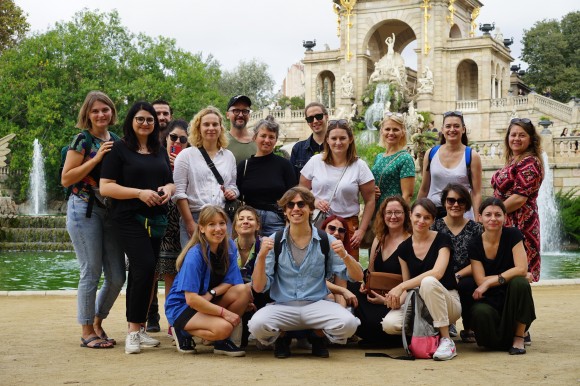
Last week, as part of an exchange of experiences organized by the Social Innovation Catalyst, our colleague Katarzyna Trzaska, project manager for the #SilesiaInnovationSpace project, visited organizations working on social innovation in Barcelona.
We invite you to read a short report in her words:
“The organizations we visited with the group from Poland were very diverse and vibrant, just like Catalonia itself. We saw firsthand that local communities here are very vibrant and autonomous, undertaking many activities for integration and the common good.
The main donors of these activities are the local government (mainly the city), but many organizations also operate successfully in the spirit of the social and solidarity economy, although they do not benefit from any financial preferences.
I recommend the organizations we had the opportunity to visit:
Impulsem – an organization working to integrate residents of the Raval district into social life and the labor market. The #Raval district, despite being located in the heart of the city, is affected by a multitude of social problems related to housing, crime, and poverty. Impulsem runs an open space where young people and children can spend their free time productively, and adults can learn crafts, operate machinery, and gain qualifications for jobs in areas such as the restaurant industry, which is a significant sector in Barcelona due to its Tourism is an important industry for the job market. The products created in the studio use local products, primarily natural ones. A great attention to locality, social responsibility, and sustainability is evident here. The organization is located right next to one of the district’s main squares. The space they create is truly impressive! All workshops are held in an open space (without walls or doors), where everyone is welcome.
Those who complete the culinary training can find employment at Norai Raval – a beautiful and very fashionable restaurant located in the Maritime Museum in the Raval district, which we also visited.
For urban innovation activities, inspiration can be found in BITHABITAT, a new municipal entity (operating since 2020) that addresses residents’ challenges in housing and transportation, and the BiciHub Barcelona bicycle innovation hub, which brings together organizations working on sustainable transportation. The hub also runs a community workshop where you can have your bike serviced for a nominal fee. Cycling is not only fashionable but also a way to access transportation for the less fortunate. Without pollution and noise, you can travel much faster than by car! Apparently, cars occupy 70% of Barcelona’s area, while only 20% of the city’s population uses them…
A visit to Caixa d’Eines i Feines, a free rental service organized by residents in the spirit of zero waste, was certainly interesting. To rent a hairdryer or grinder, you don’t have to sign any documents or even pay a deposit.
And last but not least, UpSocial – an organization that uses the Model Social Lab. In simple terms, the organization is responsible for finding best practices from around the world (“we don’t reinvent the wheel”) and finalizing them, then supporting pilot implementation and further scaling to solve a specific social problem. Some elements sounded very familiar in the context of what we do every day in #silesiainnovationspace.
Our guide to the world of NGOs in Barcelona was Aleksandra Zemke, who runs the organization Smilemundo (https://www.facebook.com/smilemundo.org/) in the field of innovation in education. I highly recommend checking out their profile.
I recommend everyone observe how our colleagues from other countries are coping with similar challenges. Perhaps we don’t always have to reinvent the wheel. And to prove that I was there and saw it, I’m posting a few photos from the KT trip.” The project is co-financed by the European Union under the European Social Fund
