
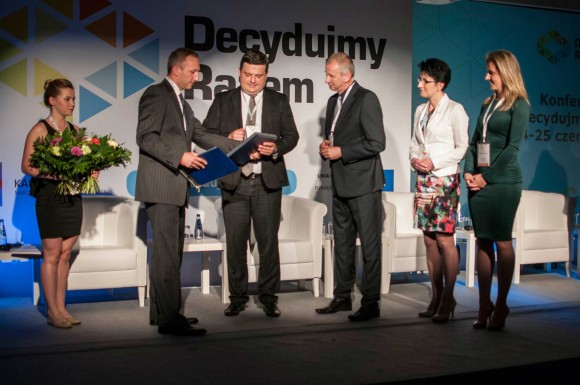
On June 24-25, the Novotel Hotel hosted the conference “Co-Decision-Making: Fashion or Modern Self-Governance,” summarizing nearly five years of the “Let’s Decide Together” project. The conference was held under the honorary patronage of Bronisław Komorowski, President of the Republic of Poland, and was organized by the Cooperation Fund Foundation. 108 participating local governments, 300 trained municipalities and counties, 60 best practices, two tested operational methods, a canon of local public consultations, 10,000 residents in working teams, and nearly 150 organizers – these are the results of the “Let’s Decide Together” project, which has officially concluded.
The project, which lasted nearly five years, is a joint initiative for local governments and local communities. Its goal was to develop and test models of public participation using social animation, as well as to disseminate and promote co-decision-making in local communities. The project resulted in the creation of a knowledge base of participants’ experiences and other identified processes, which can serve as a foundation and support for implementing mechanisms for dialogue between government and residents across the country. This knowledge was collected on the website decydujmyrazem.pl and in 50 publications, among others, with a total circulation of over 120,000 copies.
“Let’s Decide Together certainly didn’t bring about a revolution, but we can confidently say that it provided a huge impetus for evolution. An evolution in our approach to governance, in our thinking about decision-making and managing local communities,” said Jacek Ostrowski, member of the Management Board of the Cooperation Fund Foundation and the conference organizer, opening the conference. “And this evolution cannot be reversed; the question is whether we can continue to direct it well,” he added.
Paweł Orłowski, Deputy Minister of Infrastructure and Development, noted, “The project is further proof that the European Social Fund is delivering very concrete, often underestimated, results.” He added that it was no coincidence that the project was implemented under the “Good Governance” priority of the Human Capital Operational Programme (POKL). “Today, we cannot talk about good governance without participation,” he emphasized. “Governance without citizen involvement, without co-decision-making, is a mistake,” Orłowski added. Supporting local governments in good governance is key, and participation is an option and a technique for this support.
“The legal framework for participation is very broad; in fact, the law allows for everything, yet we fail to utilize these opportunities,” said Tomasz Potkański, Deputy Director of the Association of Polish Cities Office. He believes that barriers will begin to dominate development if public institutions do not work together to promote participation.
One of the most important elements of the project is the creation of the White Paper on Participation – a document that attempts to answer the question of how to systemically create an environment conducive to co-decision-making in Poland. The document describes the goals, tasks, detailed activities, and basic resources of the participation support system. It presents the management method and indicates the steps involved in taking the first steps.
Nearly 400 people participated in the two-day conference “Co-decision-making. A fad, or modern self-governance?”. On the first day, project participants discussed the evaluation of their activities and received special thanks from Minister Orłowski. The second day was open to everyone who values participation. During three panel discussions, participants jointly sought answers to the following questions: Has public participation become a part of Polish local governments? What have we learned about it from the “Let’s Decide Together” project? How do we envision the future of participation in our country?
The conference summarized several years of implementation of the “Let’s Decide Together” project. The systemic project was jointly implemented by a partnership of seven entities: the Ministry of Infrastructure and Development (Partnership Leader), the Institute of Public Affairs Foundation, the Foundation for the Development of Local Democracy, the CAL Local Activity Support Center Association, the “Partnership for the Environment” Foundation, the Foundation for Social and Economic Initiatives, and the Cooperation Fund Foundation.
