
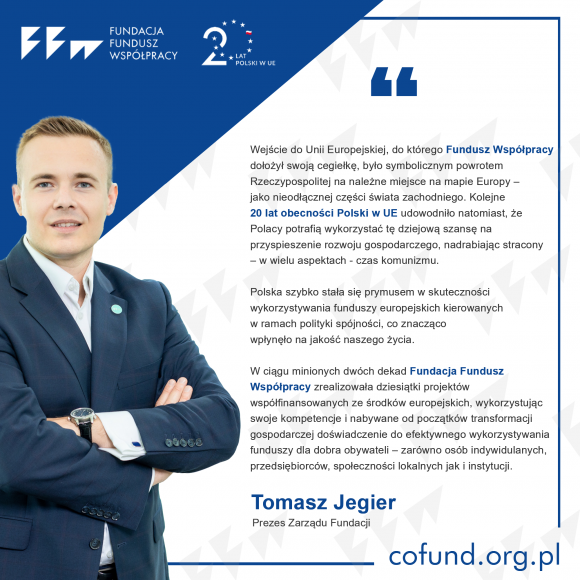
Poland has been a part of European civilization from its very beginnings. After World War II, despite playing a significant role and suffering enormous losses in the fight against totalitarianism, Poland found itself on the wrong side of the “Iron Curtain,” which separated us economically and culturally from Western Europe for nearly half a century. However, the passage of time has not changed the DNA of Poles; quite the opposite – the “Cold War” has made the West synonymous with development and prosperity for Poles. The European Economic Community – and later the European Union – appeared to people raised in the Polish People’s Republic as the Promised Land. This idealized image of the Western world meant that after the fall of communism, joining the European Community became one of the most important aspirations of Polish society, a reason of state unchallenged by any significant political force. The years-long preparations for Poland’s accession to the European Union required adapting not only regulations but, above all, the economy, including the modernization of the agricultural sector. The Cooperation Fund Foundation, established in 1990 to support the socio-economic development of Poland using foreign funds, played a significant role in managing pre-accession funds for political and economic transformation, responsible for, among other things, the implementation of the PHARE program in Poland and the Agrolinia project, which aimed to modernize the agri-food sector. Accession to the European Union, to which the Cooperation Fund contributed, was a symbolic return of the Republic of Poland to its rightful place on the map of Europe – as an inseparable part of the Western world. The subsequent 20 years of Poland’s presence in the EU have proven that Poles are capable of seizing this historic opportunity to accelerate economic development, making up for the lost – in many respects – era of communism. Poland quickly became a leader in the effective use of European funds channeled through cohesion policy, which significantly impacted our quality of life. Over the past two decades, the Cooperation Fund Foundation has implemented dozens of projects co-financed by European funds, leveraging its expertise and experience acquired since the beginning of the economic transformation to effectively utilize funds for the benefit of citizens – individuals, businesses, local communities, and institutions.
We are proud of the role we have played so far and the significant scale of our activities, but above all, we have enthusiastically begun implementing the first projects financed by European Funds under the new EU budget perspective for 2021-2027 – including: Our flagship project, “Social Premium,” for local government units, commissioned by the Ministry of Family, Labour and Social Policy, mOWES projects financed by the Funds for Mazovia, and the new edition of the “Loans for Education” project, financed by the FERS program, which will soon be launched thanks to a successful tender organized by BGK.
The Cooperation Fund Foundation was created to achieve great things. We undertake them in areas consistent with the directions of Polish development policy and international cooperation programs. European Funds are a tool that must constantly evolve, adapting to the challenges facing contemporary Europe. We believe that we face further challenges related to Poland’s presence in the EU, the upcoming Polish Presidency of the EU Council, and perhaps also leveraging Polish experience to support the accession process of candidate countries.
Tomasz Jegier, President of the Management Board of the Cooperation Fund Foundation
