
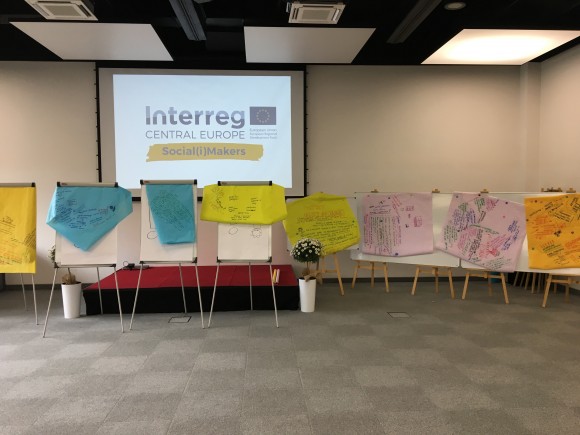
What are social innovations and who are they aimed at? What are the barriers to their development in Poland? How can they be created, implemented, and then developed? We sought solutions to these questions with participants of the world cafe workshops organized as part of the Social(i)Makers project. First Conversations at the Social(i)Makers Cafe
On April 24, 2019, the first World Cafe workshop took place at the Poznań International Fair. The meeting, held in a café-like atmosphere, featured engaging discussions, reflections, and insights revealing diverse perspectives on social innovation for dependent individuals.
Seeking answers to questions such as: How to overcome barriers to innovation? What to look for when designing innovations for dependent individuals? How (and if?) to disseminate an idea that works locally? Should we expect anything from institutions? How can we ensure innovation survive? Participants had the opportunity to develop several interesting ideas, and during a festival of failures, i.e., an exchange of experiences, they had the opportunity to learn what not to do to succeed.
“Innovation – and what next?”
The next workshop took place on May 31, 2019, at Ogrodowa 12 – Conference Center in Poznań, and served as a platform for reflection on the future of innovation after the incubator phase. The event was aimed at representatives of non-governmental organizations, social enterprises, and government agencies implementing social innovations on a daily basis.
The workshop was divided into two parts, during which participants could consider how to develop existing innovations. Participants worked on examples of the “SOS Homini” and Family Autonomy of Self-Reliance applications using the Business Model Canvas. This allowed them to identify the connections between value creation for various stakeholder groups, communication channels, and cost and revenue structures. It also encouraged participants to explore cross-sector solutions and financing options.
SOS Homini
A mobile app designed to connect dependent individuals with volunteers and enable them to request assistance, such as basic shopping, housekeeping, assistance leaving the house, handling administrative tasks, or making a doctor’s appointment.
The SOS Homini app was created with dependent individuals in mind. These may include older adults who, due to their age, cannot cope with basic daily activities, as well as individuals with temporary or chronic illnesses, individuals with disabilities, and caregivers of those who, due to difficult life circumstances, require support from others.
A video about the application is available HERE.
Family Autonomy of Independence
Through this innovation, three complementary tools have been created to support parents of individuals on the autism spectrum in the process of becoming independent. These include:
a script for activation workshops dedicated to parents and caregivers;
a brochure on independence, which serves as a dialogue between a specialist and a parent, enriched with comments from experts, parents, and caregivers of individuals with disabilities;
a set of recipes, providing practical tips and inspiration on how to support the process of becoming independent in children with varying levels of ability.
Social(i)Makers is a project implemented under the Interreg Central Europe program by partner organizations from seven Central European countries: Poland, Austria, Germany, Slovakia, Slovenia, Hungary, and Italy. The Polish project partners are the Cooperation Fund Foundation and the Regional Social Policy Centre in Poznań.
More information about the project can be found at:
https://www.interreg-central.eu/Content.Node/Social(i)Makers.html
https://www.facebook.com/socialimakers/
https://www.youtube.com/channel/UCPJOdMVjaG5cXnQtzzOHA2Q
