
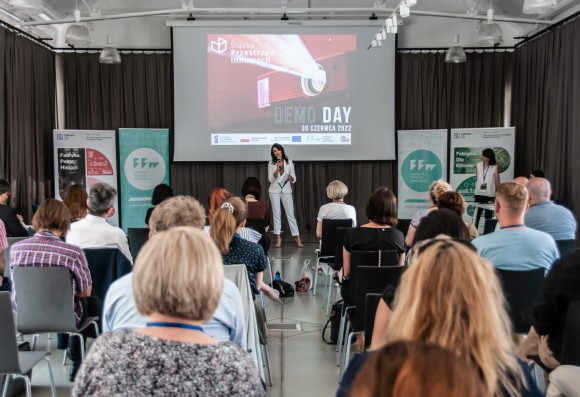
On June 30th, DemoDay 2022 took place at Fabryka PeĹ‚ona Życia in Dąbrowa Górnicza. This event gave our innovators the opportunity to present their projects. The main goal of the meeting was to present ideas for solving social problems affecting the Silesian Voivodeship, their development, and implementation ideas, which our innovators had the opportunity to test. “Today’s world is so complex that effective problem-solving requires innovative, coherent, and collaborative application of methods and tools across all collaborating sectors: public, private, and civic,” says Daniel Prędkopowicz of FFW. “The Silesian Innovation Space is a project that understands and applies this perfectly. On the one hand, we are seeking solutions to problems diagnosed at a macro scale, affecting the region and the country. On the other, we have invited local institutions and organizations to collaborate with us to “order” solutions to the problems and challenges they face daily. The relationships we have built this way, as well as our search for tailor-made innovations, have proven to be extremely effective, as confirmed by today’s presentations,” emphasized Prędkopowicz.
The presentations were closely observed by experts, who will decide which innovations will advance to the dissemination stage and receive substantive and financial support in the form of a 50,000 PLN voucher for further development. We’ll find out which project will receive this opportunity on July 15th.
The Expert Panel included: Barbara Szafir, Deputy Director of the Regional Development Department of the Silesian Marshal’s Office; Anna Bielak-Dworska, Service Designer and Director of the Stajnia Foundation; Professor Krzysztof Bierwiaczonek from the University of Silesia, specializing in urban revitalization and social innovation; Katarzyna Weideman, Board Member of the CRIS Social Initiatives Development Center; Sonia Lenarczyk, Board Member of the CRIS Social Initiatives Development Center; Daniel Prędkopowicz, Director of the Project Management Office at the Cooperation Fund Foundation; and Łukasz Wawak, Startup Development Expert at the Cooperation Fund Foundation.
The event was moderated by Anna Rękawek and featured 10 teams presenting solutions in the following areas:
Development of White Jobs
Wioletta Kosiba from the Elizjum Foundation presented two innovative solutions:
“The Nursing Profession – Not a Maid, Not a Secretary” is being implemented in response to the challenge of the Department of MIG-MED Care and Treatment Center.
“Time for a Human Being” is also being implemented in response to a challenge from MIG-MED.
Barbara Górka from the Imago Foundation presented the solution:
“E-care” – the development of white jobs through the organization of remote assistance and care services for people with special needs, implemented in response to a challenge from the Oligos Association.
The closing presentation of the section devoted to the development of white jobs was delivered by Dr. Anna Zasada-Chorab from Korczak University:
“A University Close to Seniors”
Development of Green Jobs and Mitigating the Social Impact of Energy Poverty
Magdalena and Wojciech Janosz from the Kurka Wodna Association presented an innovation in the area of green job development titled:
“Precious Plastic,” implemented in response to a challenge from the City of Radlin.
Justyna Figas-Skrzypulec representing Swarmcheck sp. z o.o. presented an innovation in the area of reducing the social impact of energy poverty entitled:
“EnergoPorada,” which responded to the challenge submitted by the City of Rybnik regarding energy poverty.
The final innovation in this block was presented by Paweł Wyszomirski, representing the informal group Paweł Wyszomirski and Błażej Faliszek:
“OpenAir – a program for financing small energy investments,” implemented in response to the challenge submitted by the City of Rybnik, also in the area of energy poverty.
Social Revitalization of Cities and Depopulation
The first presentation in this block was given by Paweł Wyszomirski, this time representing the Napraw Sobie Miasto Foundation:
“DAR – Dąbrowski Craftsman Accelerator,” implemented in response to the challenge submitted by Fabryka Pełny Życia sp. z o.o. regarding social revitalization of cities.
Another innovation was presented by the ladies from the Miastoprojekt Creative Studio: Agnieszka Stefaniak-Zubko, Agnieszka Jasińska, and Beata Nocoń. The solution is titled:
“Tool Room” and is also implemented in response to a challenge from Fabryka Pełna Życia sp. z o.o.
The latest innovation was presented by Natalia Figiel from the Teano Foundation:
“No Strangers in Our City” and is implemented in response to a challenge from the Żory Entrepreneurship Zone regarding depopulation.
We thank all the innovators for their excellent presentations of innovative solutions!
The Silesian Innovation Space project is implemented by the Cooperation Fund Foundation and the CRIS Center for the Development of Social Initiatives and is co-financed by the European Union under the European Social Fund.
