
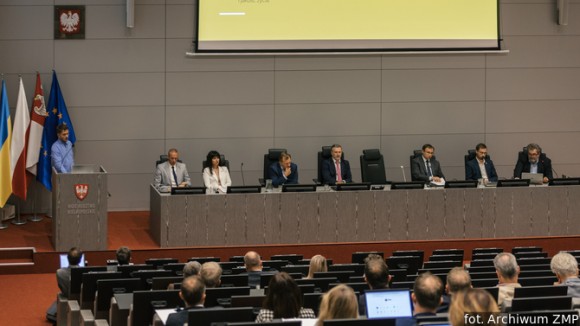
On September 13th, the Experience Exchange Forum was held in Greater Poland as part of the CWD Plus program for local government partnerships. This event allowed participants to meet with representatives of the Marshal’s Office and gain knowledge, including on support programs for 2021-2027.
Source: Association of Polish Cities, Photo: Archives of the Association of Polish Cities The Experience Exchange Forum on September 13th, hosted by the Cooperation Fund Foundation (FFW), the Association of Polish Cities (ZMP), and the Marshal’s Office of the Wielkopolska Voivodeship (UMWW), was opened by Marshal Marek Woźniak. This is one of many informational meetings of varying scope and content that the FFW will organize in all voivodeships until June 2023, with representatives of 77 local government partnerships, encompassing over 700 local government units (LGUs) participating in the CWD Plus program.
The meeting, held in the Session Hall of the Marshal’s Office of the Wielkopolska Voivodeship in Poznań, was attended by representatives of LGU partnerships from the Wielkopolska Voivodeship that have joined the CWD Plus program, as well as LGU partnerships participating in the CWD pilot program. ZMP advisors also participated.
The Advisory Support Center (CWD) is a project of the Ministry of Development Funds and Regional Policy, implemented since 2020. Its goal is to support municipalities and counties in implementing more effective and efficient development policies. As part of the project, local governments, together with a team of experts from the Cooperation Fund Foundation and the Association of Polish Cities, are learning about cooperation, strategic development planning, and preparing high-quality projects that will fuel the development of partnership areas and can be financed from various sources. The pilot project of the Advisory Support Center was completed at the end of March 2022. The new edition of the project, called CWD Plus, will be implemented until June 2023. The pilot project resulted in the development of a target model for the Advisory Support Center as a framework for advisory support for cooperation between local governments in the process of strategic development management.
Strategic management and spatial planning have always been challenging fields. Hence, the need to utilize the work of professionals, both academics and practitioners. Every local government official should seek knowledge, guidance, and best practices in this area,” said Marek Woźniak, Marshal of the Wielkopolska Voivodeship. During the Forum, the Marshal announced that partnerships established under the new EU framework will not be offered the so-called financial envelope, which will be reserved exclusively for Integrated Territorial Investments (ZITs), but they can count on preference in the competitions announced by the Marshal of the Wielkopolska Voivodeship next year. “Joint action is always more effective and efficient,” explained Woźniak.
During the meeting, academics from the Faculty of Socio-Economic Geography and Spatial Management at Adam Mickiewicz University in Poznań – co-authors of the expert report that formed the basis for the development of the handbook “Supra-Local Development Strategy. A Practical Guide” published by the Ministry of Development Funds and Policy – presented practical aspects of the functional-spatial model in the Supra-Local Development Strategy.
Dr. Hab. Łukasz Mikuła emphasized that a supra-local development strategy is, in principle, optional (similar to a municipal development strategy), but the draft Act on the Principles of Implementing Cohesion Policy Programs in the 2011-2027 Financial Perspective (Implementation Act) proposes that supra-local development strategies be mandatory for functional urban areas of voivodeship capitals (MOF OW). He also discussed planned legislative changes regarding spatial planning reform (MRiT) and the Act on Sustainable Urban Development (MFiPR). Experts from Adam Mickiewicz University advised on the data and research (e.g., migration, commuting, schools, financial flows) that should be used to prepare a diagnosis of a supra-local strategy and presented examples of graphical boards illustrating the specific scopes of the model. “Findings and recommendations in a supra-local development strategy should not repeat directives and guidelines arising from generally applicable laws and planning documents at the national and regional levels.” The supra-local development strategy offers a new tool for coordinating spatial development, although these are not legally defined within the strategic and spatial planning systems, noted researchers from Adam Mickiewicz University.
During the Forum, sector advisors – Grzegorz Roman, sector advisor to the Association of Polish Youth and Youth (ZMP) – delivered lectures on “The Spatial Structure Model as a Tool for Building Relationships between Partnerships in Wielkopolska,” and Dr. Daniel Budzeń – “The Financial Potential of Partnerships from Wielkopolska.” More information can be found in the attached presentations.
Representatives of the Department of Regional Policy at the Poznań Office of the Wielkopolska Regional Office discussed the anticipated support under the European Funds for Wielkopolska 2021-2027 project, from a territorial perspective, and the status of the Program negotiations. The first calls for proposals are expected to be announced in the first quarter of 2023. EUR 2,136,076,965 has been allocated for Wielkopolska. Importantly, according to the EU, beneficiaries cannot be entities that engage in discriminatory practices.
Piotr Przybysz from the Cooperation Fund Foundation presented other possibilities of financing partnership initiatives, e.g. by joining the URBACT network or using calls announced under the UIA (Q4 2022), currently the EUI (European Urban Initiative) or other calls for proposals for cities in the EU (EU Cities Mission – Call for Pilot Cities, PROSPOCT+ training project, Driving Urban Transition Call).
