
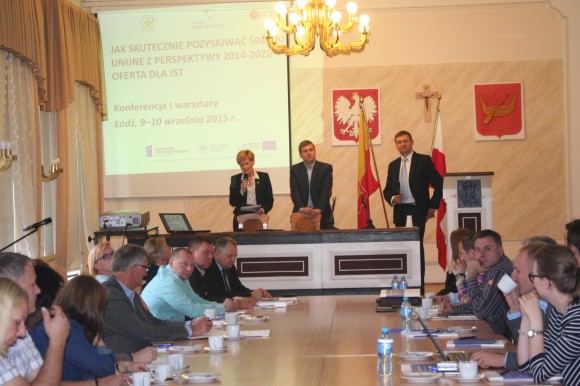
“How to effectively obtain EU funds from the 2014-2020 perspective – an offer for local government units” is an educational and informational project implemented by the Cooperation Fund Foundation in cooperation with the Association of Polish Cities and the Social Support Association “Ja Ty My” and co-financed by the Technical Assistance Operational Programme 2007-2013. Although local government officials have long been using EU funds, their funding needs remain significant. It’s no surprise, then, that the demand for knowledge that would facilitate fundraising and improve the quality of future projects is equally high.
The partnership project “How to Effectively Obtain EU Funds from the 2014-2020 Financial Framework – An Offer for Local Government Units” addressed these needs. Its goal was to present the opportunities offered by the European funding opportunities in the 2014-2020 financial framework to local government representatives, to present the key principles and conditions related to project implementation under the new framework, and to conduct active workshops on infrastructure and “soft” project writing.
The training sessions included representatives of local governments from eight voivodeships: Lower Silesia, Silesia, Opole, Lesser Poland, Podkarpackie, Łódź, Lublin, and Świętokrzyskie. Over 320 representatives of local government units participated, having the opportunity to participate in conferences and workshops between August 31 and September 23, 2015.
What will be possible?
The new budget perspective also means new rules and new priorities. What can funds be obtained for?
“Generally, everything included in the operational programs in the new perspective. Primarily, regional operational programs for the voivodeships, the innovative economy, now called smart growth, and there are also funds for infrastructure and the environment. These are the three fundamental drivers of Poland’s development until 2020,” says Marcin Pluta, vice president of the Association of Polish Cities and mayor of Brzeziny. “In practice, this means that funds will be available for water and sewage systems, as well as for new marketplaces. They can also be used to co-finance sports, recreational, and cultural infrastructure, and finally, the renovation of historic buildings. There will also be money for ‘soft’ projects.” For example, those aimed at preventing social exclusion and reintegrating as many people as possible into the labor market.
Comprehensive Knowledge
Good preparation involves both a well-thought-out plan and concept to be implemented with the funding, as well as a well-structured and written application. Therefore, the training covers all the stages a local government unit must complete if it wants to receive support. “The general idea is to prepare our members now – the cities that are members of the Association of Polish Cities and form this organization – as well as other local government officials,” Marcin Pluta outlines.
To ensure comprehensive preparation, the conference consisted of a theoretical section and workshops. On the first day, participants had the opportunity to familiarize themselves with general information about the funds and a presentation of the most important activities that local government units will be able to benefit from under individual programs. Another important issue addressed in this section was the changes introduced compared to the previous budget.
“First and foremost, we inform local governments about where the funds are available. In which programs, and under what conditions, they can be used.” We pay special attention and raise awareness of the requirements that must be met to obtain this funding,” emphasizes Katarzyna Boczek, a trainer for the Cooperation Fund.
The importance of this part of the training was also emphasized by the participants themselves, who will be using this knowledge in their work. “The training was very useful. The information, general assumptions, and application options in the new framework have very practical implications and, importantly, were presented in an accessible way,” says Ilona Tonn, Deputy Director of the Organizational Department at the Bełchatów City Hall, assessing the theoretical portion.
There are many changes, and while most of them will make life easier for applicants, they are still important to be aware of.
“Much will change in the new framework. There are many simplifications and improvements,” explains Katarzyna Boczek. “Each program used to have its own, separate rules, but now they are unified. These simplifications are also intended to shorten the process of obtaining these funds. In many places, certificates will replace declarations. You need to familiarize yourself with each program from scratch, as there will be more changes. The financing rules have also changed.” It will be possible to receive advance payments and bonuses, i.e., non-repayable assistance, especially for activities that will contribute to the creation of new jobs. There are significant funds available for implementing new technologies,” the trainer adds.
Practice is key
The second day was devoted to imparting practical skills. Even local government officials experienced in applying for EU funds admit that writing practical applications is a difficult task. During the workshops, participants had the opportunity to meet with people who work daily in the institutions accepting applications.
“It’s good that the workshops were led by people with detailed knowledge who advised us on what provisions to include in applications to achieve a better rating,” says Agnieszka Ozdoba, an employee of the Social Economy Support Department at the Municipal Social Welfare Center in Łódź.
Ilona Tonn confirms this. “During the hard, infrastructure workshops, we were given accessible information on how to logically structure an application, what elements are necessary for analysis in the general requirements, and what parameters are truly important,” adds a representative of the Bełchatów City Hall. Marcin Pluta also emphasizes the importance of practical skills.
“It is crucial to prepare for the new approach of the Ministry of Infrastructure and Development and all other implementing and intermediary institutions. They now expect greater specialization and efficiency. Social partnerships will be given higher marks.”
Municipalities are required to develop cooperation programs with non-governmental institutions, commission and entrust public tasks, and undertake joint, partnership initiatives. Partnership projects are a very significant and important challenge.
Everyone, both trainers and participants, emphasized that the training idea was a great success.
“We have a new funding perspective ahead of us; any knowledge can be useful, and we will certainly utilize it, both in terms of the information from the soft and infrastructure workshops,” Ilona Tonn summarized her participation in the conference.
Especially since this will likely be the last chance to secure such large sums of money from the European Union. That’s why it’s so crucial for local governments to be well-prepared to apply for EU funds.
Article by Zbigniew Adamów-Bielkowicz
