
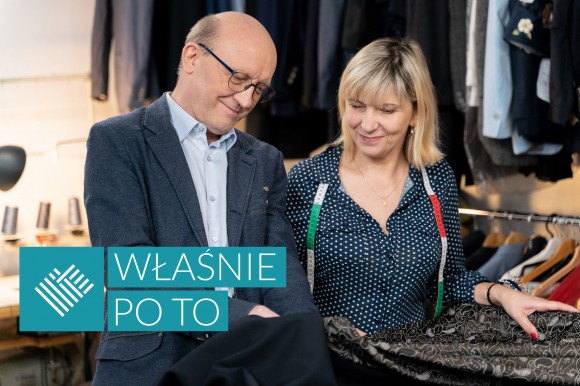
They want to act consciously, responsibly, and leave a positive mark. They want to influence the world around them. There are already several thousand social entrepreneurs in Poland who, beyond running their businesses, are doing tangible good. On World Consumer Rights Day (March 15th), the “Właśnie po to” social campaign is being launched, aiming to demonstrate that social problems can be solved through responsible consumer decisions and business methods. The campaign was supported by actor Artur Barciś, who appeared in the campaign’s commercial, available at www.wlasniepoto.biz.pl. Social entrepreneurship is increasingly being hailed as the missing link in the modern world, an essential element of the market. Research (e.g., Deloitte’s “Millennials 2018/2019 Report”) indicates that, for the new generation, consumerist lifestyles and high salaries are losing importance, and meaningful actions that impact the environment are becoming more valuable. This perspective has been held by social entrepreneurs in Poland for years, who prioritize achieving social goals and making money. A social campaign is now underway to showcase the concept of social entrepreneurship and engage consumers, employees, and entrepreneurs.
“Our campaign aims to be a powerful inspiration for those who want to embark on the path of EXACTLY THIS, who want to make informed consumer decisions and thus multiply good,” says Staśka Retmaniak, one of the campaign organizers from the BORIS Association. “We’re deliberately launching around World Consumer Rights Day to raise awareness of the importance of where we shop and the products we choose.” Thanks to this, we can influence many important aspects of our social lives, such as supporting the professional activity of people with disabilities,” he adds.
Who are social entrepreneurs? These are organizations that solve social problems using business techniques that promote values such as empathy, social solidarity, entrepreneurship, zero waste, decent work, and respect for others. These include local tailoring workshops that employ seniors, cafes that employ people with autism, and social cooperatives that support sales from local farmers.
“By purchasing from social enterprises, we can truly contribute to businesses changing the world for the better, supporting, for example, those who have been unemployed for a long time or those who have not found their place in the labor market due to their disabilities. Let’s remember that the threat of exclusion can affect any of us. It’s enough to turn fifty and become invisible to the labor market. Experiencing a mental health crisis or chronic illness can distance us from our community.” “Social entrepreneurship is the way to eliminate these negative phenomena,” says Daniel Prędkopowicz from the Cooperation Fund Foundation, a co-organizer of the campaign.
According to data from the Ministry of Family, Labor and Social Policy, there are over 1,200 registered social enterprises in Poland. Other sources indicate that there may be as many as 3,000 such entities. Nearly 400 operate in the Masovia region alone. “Anyone can start a social enterprise. All you need is a business idea and social responsibility,” says Beata Juraszek-Kopacz from the Civil Society Development Foundation, one of the campaign organizers. Data indicates that these are most often entities operating in the food service industry, such as cafes employing people with disabilities or the long-term unemployed; social integration centers that train tailors, floristry, or welders; and foundations or associations that provide employment for seniors as part of their businesses. “These are places on the business map of our country worth promoting and supporting, because for them, it’s not just profit that matters, but also people,” she adds.
“Exactly for This” is a campaign launched by organizations working to support social enterprises in the Masovia region. It is supported by the popular film and theater actor Artur Barciś, known for his role as intellectually disabled Janek Kaniewski in the series “The Delivery Guy.” After his mother’s death, the film’s protagonist decides to change his life and become independent. He becomes a postman, which allows him to gain financial independence. “Someone trusted Janek Kaniewski, my character, and saw his potential. Someone gave him a job, and thanks to that, they helped him regain independence, and to some extent, dignity. What social entrepreneurs do is incredibly important. I believe they need support. People like to help, but they need to be repeatedly shown specific problems and solutions. That’s why campaigns like “Exactly for This” are so important and necessary,” says Artur Barciś, the campaign ambassador. The idea of social entrepreneurship was popularized worldwide by Muhammad Yunus, winner of the 2006 Nobel Peace Prize and founder of numerous social enterprises in Bangladesh, including Grameen Bank, the world’s largest financial institution providing small, unsecured loans to the poor.
“Social enterprises are a good solution both for those who want to start a social business and change their local environment, and for those who want to find work there. Specialists working in social economy support centers can train such individuals, help them write a business plan, and obtain funding for the first few months of their operations,” says Edyta Obłąkowska-Woźniak of the Foundation for Social and Economic Initiatives.
The “Właśnie po to to” campaign is nationwide, with a regional focus in the Masovian Voivodeship. Its initiators are the BORIS Association, the Cooperation Fund Foundation, the Socio-Economic Initiatives Foundation, the Civil Society Development Foundation, the Krzesko Cultural and Local Activity Center Association, the Europa i My Association, and the Masovian Social Policy Center. More information about the social campaign can be found at www.wlasniepoto.biz.pl and on social media using the hashtag #WlasniePoTo.
