
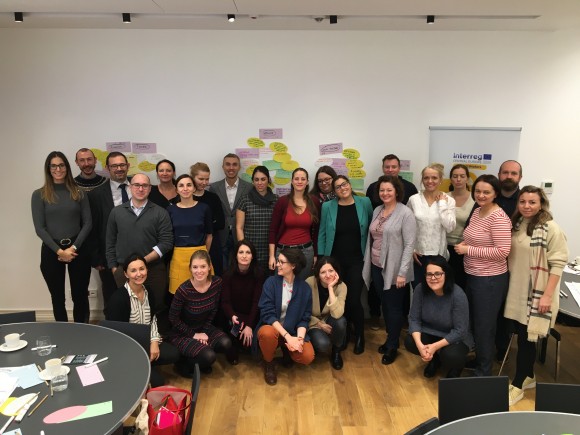
The fifth meeting of the Social(i)Makers project partners took place on November 20 and 21, 2019. This time, we were in Poznań, where, during two intensive days of work, we, along with the project team, summarized the activities of the fourth half of the year and discussed upcoming activities.
Dorota Nowicka, Head of the Foundation’s Social Innovation Department, presented the activities and opportunities offered by the Skyrocket platform to users, summarizing the first competition announced on the platform – “Be Social, Be Maker.” The meeting also provided an opportunity to discuss individual pilot projects that the partners have been implementing in their countries for several months. In Poland, the pilot project is coordinated by the Regional Social Policy Center in Poznań. During a series of presentations, we learned about the next stages of implementation of the following projects: DigiInclusionHub (Austria), Scalerator (Germany), Innovative models for employment (Hungary), Social Impact of UCDC’s initiatives (Italy), Open Future (Slovakia), and Learning by doing – SI (Slovenia). More information can be found on the project’s Facebook page.
We are currently working on a strategy for disseminating social innovations in Central Europe and will hold further meetings in Brussels and Vienna.
SOCIAL(I)MAKERS
An international project focused on creating an ecosystem supporting the development of social innovations in Central European countries through:
The Skyrocket online platform – a tool for publishing innovative ideas and solutions that address social challenges and forging collaborations with various entities. Social Innovation Academy – a free and publicly available online course consisting of seven modules guiding participants through the process of implementing social innovations – from ideation, through implementation, to impact assessment. The course is available here until the end of December 2019.
The Social(i)Makers project is implemented under the Interreg Central Europe program by partner organizations from seven Central European countries: Poland, Austria, Germany, Slovakia, Slovenia, Hungary, and Italy. More information about the project can be found on the website. The latest news is also available on Facebook.
