
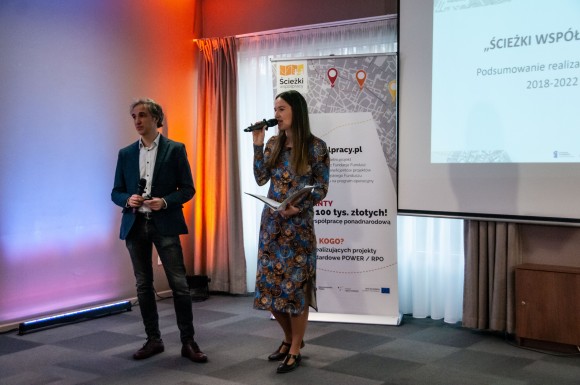
The last weeks of February were very busy for the “Cooperation Paths – Support for Entities Implementing International Cooperation” project. In parallel with the final project completion, the team organized three networking conferences for grantees.
The main goal of these meetings was to summarize all activities to date, exchange knowledge and experiences from implementing grant projects, and—above all—enable participants to establish contacts and collaborate in the future. During the conferences in Krakow (February 17), Warsaw (February 22), and Poznań (February 24), we had the opportunity to hear presentations on several selected projects implemented as part of the Collaboration Pathways. The following individuals presented their achievements:
In Krakow:
Joanna Burkiewicz, Eudajmonia Foundation, presented the “Accessible Services” project,
Magdalena Wrona, District Employment Office in Jaworzno, presented the “21st Century Consulting” project,
Beata Słowiak, CRAS Association – Center for the Development of Social Activity, presented the “Shared Responsibility – CSR in Practice” and “Youth in the European Labor Market” projects.
In Warsaw:
Małgorzata Maciecka and Jan Kostyszak, from the “Pomost” Education Association, presented the projects: “Development and Implementation of the Borderland Nursery Training Model,” “Modern Carpenter in the Labor Market,” “Intercultural Step to Volunteering,” and “Senior Cyber Club.”
Marta Gawryluk, from the Eudajmonia Foundation, presented the project “Professional Job Coach.”
Marta Kruszczyńska, from the “Ziemia Gotyku” Local Action Group, presented the project “Local Cross-Sector Partnerships for Social Inclusion.”
In Poznań:
Agata Włodarczyk-Bucharowska, Imago Foundation, presented the project “Adventure Break.”
Marta Przeczewska, Aktywa Plus Emilia Kowalska/Koszalin Regional Development Agency S.A., presented “Transfer of innovative solutions in the field of social economy from DomSpain to SZOWES-OWES in the Szczecin region.”
Hanna Kozakiewicz, Pruszcz Municipality, presented the projects: “Communication First – Implementing Techniques Based on Speaking” and “Learning Through Discovery (IBSE) – Development of Techniques for Learning and Teaching Science.”
In addition, the speakers participated in a panel discussion, during which they shared their experiences and reflections on topics such as the benefits and difficulties of transnational cooperation, the challenges of implementing international projects during the pandemic, and further opportunities for “importing and exporting” interesting social solutions.
The most important part of the conference was the extensive networking workshops, during which “Cooperation Paths” grantees worked in groups around thematic areas related to their activities: education, professional activation, social inclusion, and institutional development. Furthermore, using open space technology, they had the opportunity to discuss the completely new challenges their organizations will face in the future.
Summary of “Cooperation Paths” in numbers:
Over 3.5 years of implementation
46 orientation meetings with potential applicants held
282 grant applications submitted
225 transnational partnerships established with partners from 24 EU countries
208 grants of up to PLN 100,000 awarded to initiate transnational cooperation
Total amount of grants awarded: PLN 17,106,420
Average grant amount awarded: PLN 82,242
208 new social solutions were developed and implemented.
32 thematic and horizontal networking seminars were held.
1 network of entities was established.
1 summary publication was prepared: Collaboration Paths – a catalog of social solutions developed as part of the project, available at: www.sciezkiwspolpracy.pl/katalogrozwiazan
