
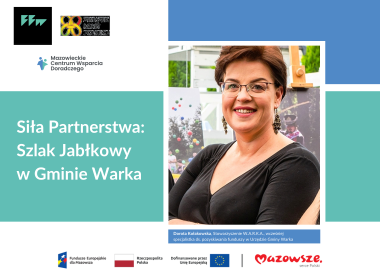
As part of the Masovian Advisory Support Center project, experts from the Cooperation Fund Foundation and the Association of Polish Cities support local governments by providing expert knowledge on how to effectively apply for development funds. They also work to build strong local partnerships at the municipal level and foster cooperation between local governments and NGOs. Today, we present one such story. FFW: How did your involvement in the Masovian Advisory Support Center – MCWD project begin?
Dorota Kołakowska, (W.A.R.K.A. Association, previously a fundraising specialist at the Warka Commune Office): Our involvement in the MCWD project began in the Żyrardów Functional Area. When the project was just beginning, we were informed that Marcin Bzdyra would be our consultant and expert, and that he would support us in writing applications and establishing partnerships. It was he who drew our attention to the hiking trail project. This wasn’t a surprise; we were already aware of the project. However, the scope itself was difficult to determine because the competition documentation hadn’t yet been prepared. Together with our expert, we began intensively working on a new project concept. After the elections, we modified and adapted our needs to the new opportunities. At first, we thought we didn’t have enough time. But the information from Marcina Bzdyra proved crucial. Thanks to her, we re-engaged the project and built a project partnership.
I understand that other municipalities also participated in this partnership?
We narrowed our partnership somewhat at the meeting in Żyrardów – we decided to work in Grójec County to make the joint development of the project more realistic. We met in one of the municipalities at that time and decided to hold such meetings in various municipalities. There was a meeting in Warka, and then the first meeting in Goszczyn, where we discussed the possibility of developing this tourism project.
And what did the subsequent work look like?
We moved from a broad perspective of the entire Żyrardów area, this partnership, to a lower level – Grójec County. And already in Grójec County, I initiated the following topic: “Listen, there’s an idea for a project concerning the development of the Apple Trail. If you want to join, I invite you to a meeting in Warka.” And we continued our discussions with those municipalities that were interested in collaborating.
What is the project itself about?
The “Development of the Apple Trail in Europe’s Largest Orchard” project is consistent with the development of existing tourist trails. Since this topic arose during the development of the Żyrardów Functional Area strategy, the Warka Commune ensured that such a project was included on the list of projects in that strategy. In our region, the Apple Trail has been operational since 2017. I think, in part, because I lead this initiative on behalf of the W.A.R.K.A. Association, I was keen to seize this opportunity to raise new funds. But I was also aware that an NGO wouldn’t be able to manage such a large project if we truly wanted to achieve something significant. Fortunately, there was openness from the Warka City Hall and the new mayor, who addressed the issue.
What is most important to you about this project?
A key and groundbreaking element for the Trail’s development is the creation of the Apple Trail Center in the center of Warka. This plan had already occurred to the Trail’s creators, but it was beyond the financial reach of the initiators. When the opportunity arose to secure EU funding, this bold idea was approved by Mayor Tomasz Rawski.
It will be a place where tourists can learn about the fruit-growing potential of our region and the facilities along the trail. There will be an information point for tourists and a multimedia exhibition, as well as a space for culinary workshops. The Apple Playground will be unique – probably the first such place in Poland with a playground inspired by apples, where children can play safely while learning about apples, fruit-growing, and the entire production process – something that naturally stems from the nature of this initiative and the history of the region. We also have elements related to the trail’s infrastructure – we want to install new information boards and promote the Trail through a modern website and promotional publications. We want the Apple Trail to appeal to a variety of audiences – individual tourists, families with children, and larger groups, such as school trips.
So, you could say the project has both an infrastructure and educational aspect?
Exactly. We want it to be a place where you can spend time in an interesting way, but also learn something interesting about the judiciary, which is a key part of our region. That’s why we were so keen on this advisory support – we wanted this project to be well-thought-out, not just meet the formal requirements.
And what stage are you at now?
The municipality has already received information about the funding. If everything goes according to plan, implementation should begin soon. We’re keeping our fingers crossed and hope we can implement this project, as we truly see great potential for the development of tourism in our region. Soon, children will be able to use the toys under the symbolic apple tree and expand their education. I think this was also the driving force behind this project. Together with Marcin Bzdyra, we managed to rationalize this project so that it fit the competition framework.
Indeed, when there’s an idea and you’re involved, and it’s justified, it’s much easier to do something like that…
Exactly. I also don’t deny that we always write projects to score the highest possible number of points and have a chance of receiving funding. We look at the criteria – for example, partnerships are scored. Here, I had very clear support from the MCWD. Our expert also remembered something I wasn’t aware of. The point was that if we wanted to form a partnership with an NGO, we had to formally advertise on the leader’s website for a call for potential partners. If it weren’t for Marcin Bzdyra’s suggestion, we would have lost the chance for this partnership.
As the Cooperation Fund Foundation, we work with NGOs every day. We have experience in local activities and support initiatives like “Mazowsze Lokalnie” (Local Mazowsze). Such issues are close to our hearts. We are very happy to be able to make a real difference and help you.
I wanted to add one more thing. I smiled because I remembered something. The Apple Trail was created as part of the Polish-American Freedom Foundation’s Local Partnerships project in 2017. The W.A.R.K.A. Association submitted a partnership project, and one of its outcomes was the creation of this trail. While writing this project, we had a mentor – an animator who provided us with guidance, somewhat like Mr. Marcin does now. This animator was Daniel Prędkopowicz, the current President of the Cooperation Fund Foundation. I remember a meeting at the Marshal’s Office you attended, and I said we needed support because we felt like children in a fog. Daniel Prędkopowicz replied: “But you have experience with local partnerships.” He was right! This experience, though not within this specific project, but more generally – with the Cooperation Fund and Daniel Prędkopowicz – manifested itself at various stages. The combination of non-governmental organizations and local government yields excellent results. This was the first partnership project of the Warka commune and probably the first EU partnership project in the entire Grójec County. Engaging NGOs in collaboration with local governments is crucial. Some operate formally, others less so – it all needs to be coordinated, and the Foundation and projects like MCWD are a great help.
Thank you for the interview. See you on the Apple Trail!
More information about the Apple Trail project
