
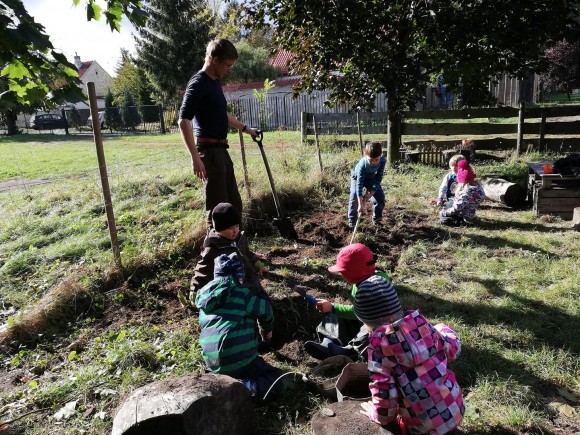
As part of promoting the idea of forest preschools and the Foundation’s partner project, the Forest School Center, one of our experts, Dariusz Matusiak, conducted an interesting conversation with Paweł Galiński, a teacher at such a facility. We invite you to read:
__ Dariusz Matusiak (DM): As a capoeira instructor, you practice martial arts and train adults and children on a daily basis. What led you to become an educator at a forest preschool?
Paweł Galiński (PG): My work with children began by leading capoeira training for children, where Capoeira Angola is a multifaceted art combining elements of dance, theater, music, and martial arts, but it also teaches teamwork. Then, for a year, I was a caregiver (nanny?) for a 2-year-old boy. When I accidentally stumbled upon a job posting at a forest preschool online, I immediately knew it was for me.
DM: It’s very rare to find men as educators in preschools. Did you have any internal reservations about working with 4-6-year-old children?
PG: The thought never crossed my mind. Besides, I’ve always enjoyed breaking stereotypes. DM: The forest is a fascinating place for children, where both imagination and the need for exploration offer ample scope.
PG: The impact of the forest on a child is multifaceted. Above all, the forest provides the opportunity to explore the world daily using all the basic senses. Another important thing the forest offers is the endless scope for developing creativity. In the forest, where there are no toys that are already concrete, anything can be anything—meaning the possibilities of a stick are limited only by a child’s imagination. Another important thing for me is a child’s physical development. Moving around in the forest requires a greater and more varied range of movement, which naturally affects a child’s motor development.
Besides, I deeply believe that living in harmony with nature develops qualities such as respect, mindfulness, empathy, and a broadly defined peace of mind.
DM: The forest is also a rather dangerous place, where you can impale yourself on a branch, fall into a fall, or bathe in a stream. How do you cope with such situations?
PG: I believe that a forest is no more dangerous than an urban environment, where everything is in constant motion and rush. I think people in cities tend to live under greater stress, which, in my opinion, is the greatest danger and certainly affects children. In my work, serious accidents are very rare, and I treat everyday, small accidents like tripping as simply learning through mistakes. Besides, we always warn children about potential, greater dangers.
DM: Were there any difficult moments when you doubted the wisdom of your decision?
PG: Every job has its difficult moments, and it’s no different at the forest kindergarten. I’ve never doubted the wisdom of my decision, although I admit that winter is the biggest challenge.
DM: What’s a day like at the kindergarten when you go to the forest?
PG: We start the kindergarten day with a gathering of the children. Then there’s a breakfast circle, during which everyone has a chance to express their opinions. We also present our daily schedule in this circle. We spend up to four hours a day in the forest. We believe in the power of spontaneous and free play, but we also organize various developmental activities.
DM: And when it rains, do children get bored?
PG: It depends on the type of rain and its duration. Generally, children love playing with and in water.
DM: Are there any challenges faced by children in forest preschool where the role of men is particularly important?
PG: I don’t see any specific roles that I fulfill as a man in education. I only know that the world isn’t made up of only women. We could probably find some activities that are more masculine or feminine. It would also be interesting to ask the children what they like to do with me and with my teammates. I believe that having a man in preschool education is important precisely because it ensures a balance in contact with adults.
DM: Would you recommend working as a forest preschool educator to other men who would like to work with children?
PG: Absolutely! Man, working with children is great! And working in daily contact with nature is incredibly satisfying. It’s hard for me to think of a more enjoyable job than working at a forest kindergarten.
DM: Thank you for the interview.
